Bubble Vortex
- 4.4
- Rating
- 10.00K
- Installs
- Free
- Price
 Analysis by App-foxy
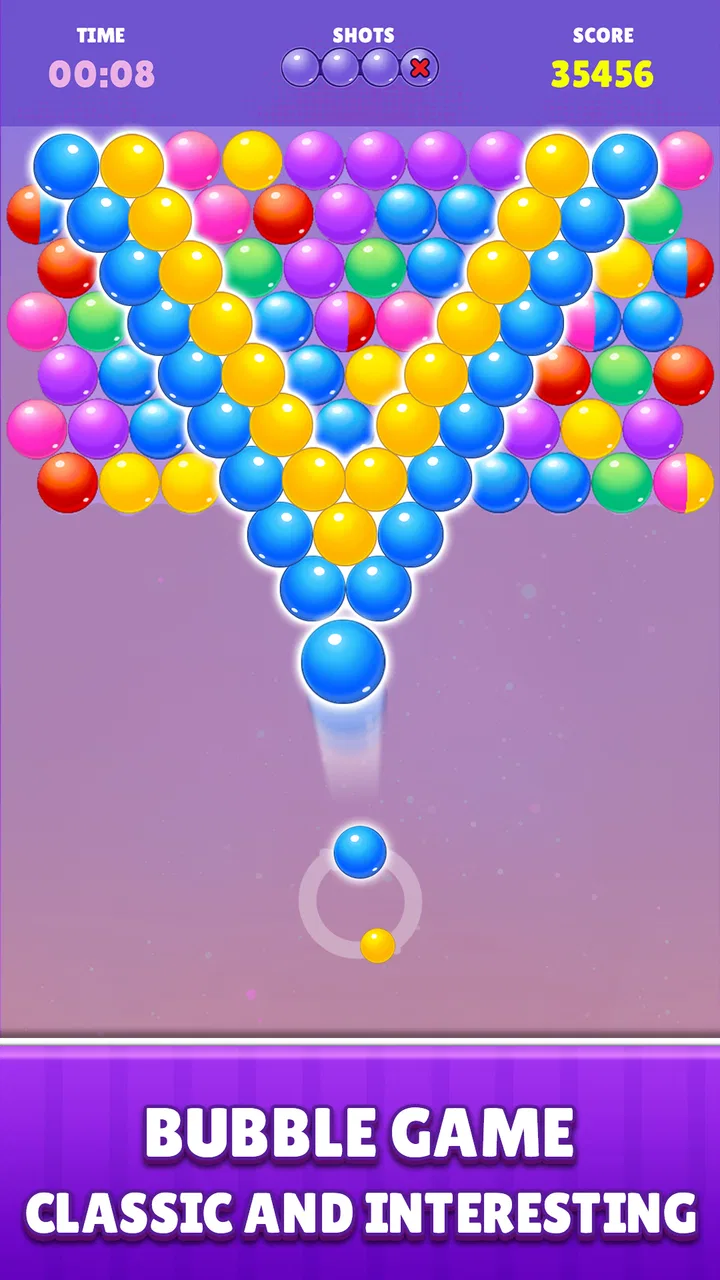
Bubble Vortex is a free trivia game from FatMan Studio that puts one simple action at the center of the experience: popping bubbles while the play area spins and matches unfold. That combination gives it a different feel from a standard question-and-answer quiz. Instead of sitting still and reading through a long list of prompts, I found myself reacting to movement, watching the vortex, and deciding when to act. The result is light, accessible entertainment that works best in short sessions.
The game is listed for Everyone, runs on Android devices using version 7.0 or later, and is currently at version 1.0.2. It has reached over ten thousand installs and holds a 4.4 average from more than three hundred ratings. Those figures suggest a small but interested audience rather than a huge mainstream community, which fits my impression: this feels like an easy game to pick up when I want a quick distraction, not a sprawling trivia platform that expects daily commitment.
Why the spinning bubble board matters
The most important capability here is the combination of bubble popping and a rotating play space. In a conventional trivia game, the challenge usually comes from memory, speed of reading, or choosing between answers. Bubble Vortex adds a physical layer. The target is not simply something I identify; it is something I need to follow as the board changes orientation. That extra movement makes even a familiar question feel more active.
You May Also Like

 AccuWeather: Weather Radar
AccuWeather Review: A Quick, Clear Forecast for Everyday Decisions
For everyday plans, the best forecast is the one you can understand quickly. AccuWeather makes rain timing, radar, and local conditions easy to act on, with a few trade-offs.

 Hill Climb Racing
Why Hill Climb Racing Still Turns Crashes Into One More Run
A tiny car, a bumpy hill and one more upgrade: Hill Climb Racing keeps resurfacing because its simple chaos makes every near-miss feel personal.

 AliExpress - Shopping App
AliExpress Makes Global Shopping Feel Personal, but Shoppers Bear the Risk
AliExpress turns a global marketplace into a pocket-sized discovery engine. Its reach is useful, its shopping loop compelling, and its trade-offs easy to miss.

 Lords Mobile: Kingdom Wars
Lords Mobile Is a Kingdom-Building Routine, Not a Quick Match
A case-by-case verdict on the building, battles, device demands, and social commitments that make Lords Mobile rewarding for some players and exhausting for others.

 PDF Scanner app - TapScanner
TapScanner Makes Paperwork Easier to Capture, Check, and Share
TapScanner makes scanning with a phone feel less like a rescue operation and more like a dependable step in getting work done. Its capture tools are useful, though not flawless.

 Block Blast!
 Shows How Much a Puzzle Game Can Leave Out
A quiet grid game shows why puzzle players increasingly value instant clarity, repeatable skill and low-pressure play—and where the genre still needs to catch up.
More From Our News Desk
View All News


I like this approach because it changes the rhythm of trivia without requiring complicated controls. The basic idea is easy to understand: watch the bubbles, recognize the useful match, and pop at the right moment. The spinning vortex creates pressure through positioning rather than through a dense ruleset. For a casual player, that means the game can feel engaging within moments of opening it.
There is also a useful difference between knowing an answer and successfully acting on it. A player might recognize the correct bubble but hesitate while the board rotates. Conversely, quick fingers do not help much if the player is not paying attention to the trivia element. The game rewards attention in two directions at once: understanding what is on screen and responding before the changing layout makes the opportunity less convenient.
That design makes Bubble Vortex more suitable for people who find ordinary quizzes too passive. If I am waiting for an appointment or taking a short break, I would rather interact with a moving board than repeatedly tap through static answer cards. It is still approachable enough for someone who does not normally play puzzle games, because the central action remains immediately readable.
What a short session feels like
In practice, the game’s appeal depends on how comfortable I am with visual tracking. The vortex is not merely decoration; it affects where I look and when I tap. I need to avoid staring at one fixed point and instead scan the changing arrangement. That makes the experience more involving than a basic quiz, but it can also make a session feel busier than expected.
My best approach is to watch the overall movement first rather than chase every bubble individually. Once I understand the direction and pace of the rotation, I can anticipate where a useful target is likely to move. This is one of the more practical lessons of the design: reacting at the last possible instant is often less comfortable than preparing one moment earlier. The game becomes smoother when I treat the vortex as a pattern instead of random visual noise.
That habit also helps with accuracy. Rapid tapping may feel energetic, but it is not automatically effective when the board is in motion. I get better results by keeping my eyes on the relevant area, waiting for a clear opportunity, and then making one deliberate tap. This is a small but meaningful trade-off between speed and control, and it gives the game more depth than its simple premise suggests.
Because the game is free to download, it is easy to try without making a commitment. The free entry point is particularly useful for families or casual players who want to see whether the spinning format feels comfortable. The age classification of Everyone also makes the presentation broadly approachable. Still, free access should not be confused with a completely cost-free experience: in-app purchases range from $2.99 to $99.99 per item, so I would check the purchase flow carefully before handing the device to a child.
Using the movement instead of fighting it
A common mistake is to treat the rotating board as an obstacle that must be ignored. I found it more useful to let the movement guide my timing. Rather than trying to memorize a bubble’s exact position, I pay attention to its path and wait for it to come into a comfortable tapping position. This reduces frantic corrections and makes the game feel more deliberate.
Another practical tip is to play with the device held steadily. Small hand movements can make a visually active screen harder to follow, especially during a quick session on a phone. I prefer resting the device in one hand and using the other for taps, or placing it on a table when I want more control. That is not a special setting or hidden mode; it is simply the kind of everyday adjustment that makes this particular design easier to read.
Screen size also affects the experience. On a compact phone, the vortex can feel concentrated and immediate, which suits fast reactions but leaves less room for visual separation. A larger display gives me more breathing space when tracking the rotation. I would not choose a new device just for this game, but people with eyesight or coordination concerns may find a larger screen more comfortable than a small handset.
The best everyday use for Bubble Vortex
The strongest scenario is a short break when I want something more active than scrolling but less demanding than a full-length game. Imagine waiting for a train with a few minutes to spare. A traditional trivia app might ask me to read several questions and remember where I left off. Bubble Vortex is better suited to that moment because its central interaction is immediate: open it, focus on the moving bubbles, and play until I need to put the phone away.
It can also work as a casual shared activity. One person can watch the board while another suggests what to look for, although the game is still primarily designed around individual tapping rather than a formal group mode. I would use it with a younger family member as a quick reaction-and-attention game, while keeping purchases protected. The Everyone rating supports its broad accessibility, but supervision around spending is still sensible because the purchase range includes a high-priced option.
For trivia fans, the attraction is not necessarily deep knowledge testing. The more interesting use is as a change of pace between conventional quizzes. After several rounds of static questions, the rotating board offers a more physical challenge. It asks me to stay visually engaged, which can make a short session feel lively even when I am not in the mood for a serious brain-training routine.
It is less convincing as a long, uninterrupted replacement for a large trivia collection. The verified store summary focuses on popping bubbles in matches and exploring the vortex world, so I approach it as a focused gameplay idea rather than expecting the breadth of a major quiz platform. If my priority is learning detailed facts, tracking categories, or competing through a large community, I would choose a more specialized trivia alternative. Bubble Vortex earns its place through interaction, not through promising an encyclopedic experience.
Who should skip it
I would skip this game if rotating visuals make me uncomfortable or if I strongly prefer calm, static interfaces. The same movement that gives Bubble Vortex its personality may be the reason another player finds it tiring. It is also not the best choice for someone who wants a purely knowledge-based quiz where every result depends on recall rather than timing and visual coordination.
Players looking for a deep progression system should also set expectations carefully. The available description establishes the bubble-popping vortex concept, but it does not position the game as a large role-playing experience or a comprehensive competitive platform. I would not install it expecting a long narrative, a detailed collection system, or a substitute for a full puzzle campaign. Its value is concentrated in the immediate loop.
Parents should pay attention to the purchase controls even though the content rating is Everyone. The game is free, which lowers the barrier to trying it, but optional purchases can cost from $2.99 to $99.99 per item. I would enable device-level purchase protection before letting a child play independently. That is a practical precaution, especially because an accessible game can be tempting to tap through without thinking about account charges.
Trade-offs behind the simple design
The biggest strength and weakness are connected. Bubble Vortex is easy to understand because it centers on one clear action, but that focus may feel narrow to players who need constant variety. I appreciate games that know what they are trying to do, and this one does not bury its main idea under unnecessary complexity. At the same time, anyone expecting a broad trivia package may find the experience less satisfying than a conventional quiz app with many categories and formats.
The spinning board creates tension without making the controls difficult, but it also raises the demand on concentration. I cannot play it as passively as I might play a static multiple-choice quiz while half-watching television. That can be a benefit during a short break, because the game holds my attention, yet it is less convenient when I want background entertainment.
There is a second trade-off in the timing. Deliberate play improves control, but waiting too long can mean missing the moment. I enjoy that small decision because it gives the bubble popping a sense of rhythm. Players who prefer instant, forgiving taps may find the movement frustrating until they learn to anticipate it. The game is approachable at the rules level, but not every screen state will feel equally comfortable on a first attempt.
The current version, 1.0.2, also places the game in an early stage of its life. That is not a criticism of the developer, FatMan Studio, but it is a reason I would treat the experience as a focused casual release rather than a mature platform with years of accumulated content. The audience size, with over ten thousand installs, is modest as well. I would not choose it primarily for a large social scene or a widely established competitive community.
Still, the early and focused nature can be appealing. There is less to learn before the first useful interaction, and the game does not demand that I build a complicated routine around it. For a person who wants a compact Android trivia game with a visual twist, that restraint may be more valuable than a long list of modes.
How it compares with familiar alternatives
Compared with a standard trivia app, Bubble Vortex gives up some of the quiet, reflective pace in exchange for movement. A conventional quiz is better when I want to concentrate on wording, compare answers, or learn from explanations. Bubble Vortex is better when I want the act of answering to involve my hands and eyes as well as my memory.
Compared with a typical bubble-popping puzzle, it adds a trivia identity instead of relying only on color matching or board clearing. That makes it a useful middle ground for players who enjoy casual arcade actions but do not want a purely reflex-based game. The trade-off is that it may not satisfy someone seeking the strategic planning of a deeper match puzzle or the extensive knowledge coverage of a dedicated quiz app.
In other words, I would not call it a universal replacement for either category. I see it as a hybrid for a specific mood: I want quick interaction, a moving target, and enough trivia flavor to keep the session from feeling like a reflex test. That is a narrower promise, but it is also the reason the game stands out.
Who gets the most from this game
Bubble Vortex is most rewarding for casual players who enjoy learning a simple control pattern and then improving their timing. It suits people who have a few spare minutes, like visual activity, and want something more involving than tapping through static screens. It can also appeal to trivia fans who are willing to trade some pure knowledge testing for a more physical challenge.
I would recommend it to a friend who says ordinary quiz apps feel repetitive but who does not want a complicated game. The rotating vortex gives the familiar idea of matching and answering a distinct identity, while the control scheme remains approachable. The fact that it is free makes trying it straightforward, although I would keep the purchase warning in mind and secure the account before sharing the device.
I would recommend a different option to someone whose main goal is serious study, detailed explanations, or broad category coverage. I would also point motion-sensitive players toward a calmer alternative. Bubble Vortex is not strongest when judged as an encyclopedia or a long-form campaign; it is strongest when judged as a compact game built around visual timing.
My final impression is positive but specific. FatMan Studio has built the experience around a capability that genuinely changes how trivia feels: the board keeps moving, so recognizing the right bubble is only part of the task. I enjoy that extra layer when I want an energetic break, and I think the game earns a place on an Android device for that reason. Just approach it for what it is—a focused, free-to-start trivia game with a spinning bubble mechanic—and it becomes much easier to decide whether it matches your play style.
FAQs for Bubble Vortex
01What is Bubble Vortex and how does the gameplay work?
Bubble Vortex is a bubble-shooting puzzle game built around aiming, matching, and clearing groups of bubbles before the board becomes difficult to manage. You usually launch a colored bubble toward clusters of the same color to create matches and remove them. As you progress, levels may introduce obstacles, limited shots, special bubbles, and increasingly complex layouts that require careful planning rather than random shooting.
02Is Bubble Vortex free to download and play?
Bubble Vortex can generally be downloaded and played without an upfront purchase, making it accessible for users who want a casual puzzle experience. However, free games commonly include optional advertisements, in-app purchases, or both. These may provide extra boosters, additional attempts, cosmetic items, or other conveniences. Before downloading, check the store listing for the current pricing, advertising details, and supported payment options.
03Does Bubble Vortex require an internet connection?
The basic bubble-shooting gameplay may work without a constant internet connection, which is useful when playing during travel or in areas with limited coverage. Nevertheless, some features can depend on online access, including advertisements, cloud synchronization, special events, leaderboards, updates, and purchases. Availability can vary by version and device, so it is best to test the game offline after installation rather than assuming every feature will remain available.
04Is Bubble Vortex suitable for children and casual players?
Bubble Vortex is generally easy to understand because its main controls involve aiming and launching bubbles, making it approachable for casual players and younger audiences. Even so, parents should review the age rating, advertising, in-app purchase settings, and privacy information before allowing children to play. Later stages may become more challenging, while timers, limited moves, or optional purchases could affect the experience.
05What should I check before installing Bubble Vortex on Android or iOS?
Before installing Bubble Vortex, confirm that your phone or tablet meets the required operating-system version and has enough free storage for the game and future updates. It is also worth reviewing recent user feedback, permissions, privacy practices, advertising behavior, and in-app purchase information. If you use an older device, check performance expectations, since animations and frequent advertisements may affect battery life or responsiveness.
Pros
- Fast-paced levels make short play sessions enjoyable.
- Simple controls are easy for new players to understand.
- Bright visuals and effects give the game a cheerful style.
- Increasing difficulty keeps later stages challenging.
- Works well for casual play without requiring much time.
Cons
- Some levels can feel repetitive after extended play.
- Frequent effects may become distracting during busy stages.
- Progress can feel slow when goals require repeated attempts.
- The game may encourage optional purchases for faster progress.
- Older devices may experience reduced performance in intense scenes.

Bubble Vortex
Gallery